


The Reason Israel Wandered in the Desert for 40 Years


The Israelites wandered in the desert for 40 years after being freed from slavery in Egypt before entering Canaan. In reality, the journey from Egypt to Canaan was only about a ten-day trip, covering roughly 200 kilometers (124 mi), similar to the distance between Washington, D.C. and Philadelphia. However, God let the Israelites wander in the desert for 40 years. Why was this?
Index
1. The Incident at Kadesh Barnea
2. It Seems Like God Has Forgotten Us
3. God Did Not Forget Them
4. “We Are Your Examples”
The Incident at Kadesh Barnea
The decision for the Israelites to wander in the desert for 40 years was made in the second year after their exodus from Egypt, due to a series of events at Kadesh Barnea.
Two years after leaving Egypt, the Israelites arrived at Kadesh Barnea in the Desert of Paran, very close to Canaan. Moses spoke to the Israelites at this location.
“See, the LORD your God has given you the land. Go up and take possession of it as the LORD, the God of your fathers, told you. Do not be afraid; do not be discouraged.”
(Deuteronomy 1:21)
The Israelites suggested that they would explore the land before entering Canaan. Moses selected twelve spies, one from each tribe, and sent them to explore Canaan.
“Let us send men ahead to spy out the land for us and bring back a report about the route we are to take and the towns we will come to.” The idea seemed good to me; so I selected twelve of you, one man from each tribe.
(Deuteronomy 1:22)
The twelve spies explored the entire land of Canaan for 40 days, from the southern Desert of Zin to the northern regions of Hamath and Rehob. Near Hebron, in the Valley of Eshcol, they picked some delicious fruits.
As God had promised, Canaan was a fertile and rich land. The spies brought back a large cluster of grapes so big that it had to be carried on a pole between two men, proving the land’s abundance.
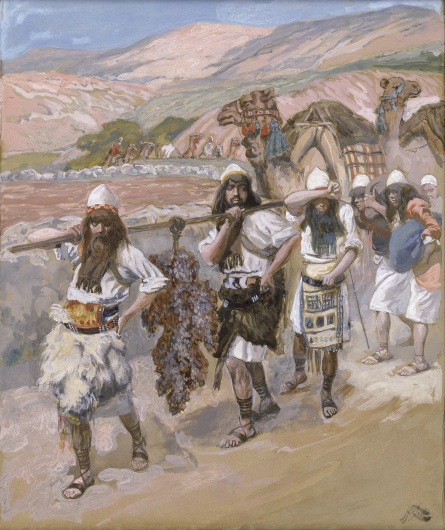
However, the land was inhabited by formidable giants. The warlike Amalekites lived in the south, the Hittites, Jebusites, and Amorites occupied the hill country, and the Canaanites lived along the coast and in the Jordan Valley.
Caleb, son of Jephunneh, reassured the people, urging them to go up and take possession of the land, confident that they could overcome the inhabitants. But the other spies disagreed.
“The land we explored devours those living in it. All the people we saw there are of great size. We saw the Nephilim there (the descendants of Anak come from the Nephilim). We seemed like grasshoppers in our own eyes, and we looked the same to them.”
(Numbers 13:32–33)
“Can we really drive out the giants and take possession of the land of Canaan?”
This question divided the spies’ opinions. Joshua and Caleb insisted that with God’s help, they could conquer the land. However, the other ten spies said they felt like grasshoppers, compared with the giants, and believed they could not win.
That night, the Israelites wept and complained against God.
“If only we had died in Egypt! Or in this desert! Why is the LORD bringing us to this land only to let us fall by the sword? Our wives and children will be taken as plunder. Wouldn’t it be better for us to go back to Egypt?”
(Numbers 14:2–5)
When Joshua and Caleb heard this, they tore their clothes and shouted:
“The land we passed through and explored is exceedingly good. If the LORD is pleased with us, he will lead us into that land, a land flowing with milk and honey, and will give it to us. . . . And do not be afraid of the people of the land, because we will swallow them up. Their protection is gone, but the LORD is with us. Do not be afraid of them.”
(Numbers 14:7–9)
However, the people instead threatened to stone Caleb and Joshua to death. At that moment, the glory of God appeared before the tents of Israel. God was enraged at the Israelites’ unfaithfulness and complaints. He declared that all those over 20 years old, except for Joshua and Caleb, would not enter the land of Canaan but would die in the desert.
“ ‘In this desert your bodies will fall—every one of you twenty years old or more who was counted in the census and who has grumbled against me. Not one of you will enter the land I swore with uplifted hand to make your home, except Caleb son of Jephunneh and Joshua son of Nun. . . . Your children will be shepherds here for forty years, suffering for your unfaithfulness, until the last of your bodies lies in the desert. For forty years-one year for each of the forty days you explored the land-you will suffer for your sins and know what it is like to have me against you.’ ”
(Numbers 14:29, 33–34)
Because of this incident, the Israelites were doomed to wander in the desert for 40 years, one year for each day they explored the land of Canaan.
Did God deliver the Israelites from Egypt only to let them die at the hands of giants? No. God had responded to their cries for liberation from Egypt. He loved them and delivered them from a land of oppression and hard labor, promising to give them a land flowing with milk and honey. However, the Israelites ended up grumbling against and blaming the very God they had once cried out to. How did they come to this point?
It Seems Like God Has Forgotten Us.
The Israelites did not grumble against God from the beginning. They praised Him for freeing them from slavery in Egypt. However, the difficult journey through the desert, which they thought would be short, turned out to be much longer than expected. Gradually, the immediate reality began to overshadow the promise of Canaan in their minds. Losing confidence in God’s promise, they found it hard to endure the endless desert and its challenges. Everything became a test for them.
When the Red Sea blocked their path:
“Was it because there were no graves in Egypt that you brought us to the desert to die? What have you done to us by bringing us out of Egypt? Didn’t we say to you in Egypt, ‘Leave us alone; let us serve the Egyptians’? It would have been better for us to serve the Egyptians than to die in the desert!”
(Exodus 14:11–12)
When there was no water to drink:
So the people grumbled against Moses, saying, “What are we to drink?”
(Exodus 15:24)
“Why did you bring us up out of Egypt to make us and our children and livestock die of thirst?” . . . because they tested the LORD saying, “Is the LORD among us or not?”
(Exodus 17:3, 7)
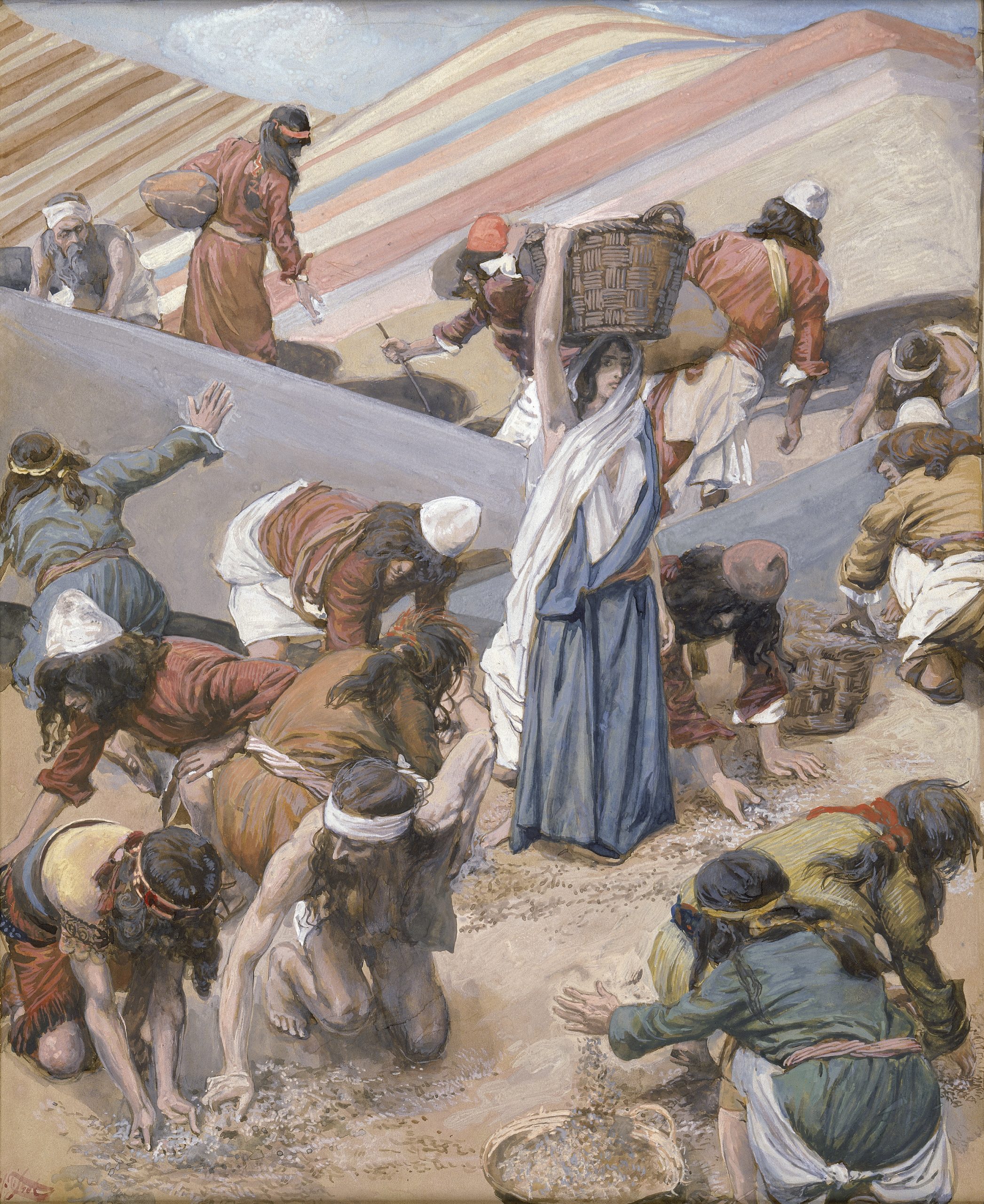

When they ran out of food:
The Israelites said to them, “If only we had died by the LORD’s hand in Egypt! There we sat around pots of meat and ate all the food we wanted, but you have brought us out into this desert to starve this entire assembly to death.”
(Exodus 16:3)
“If only we had meat to eat! We remember the fish we ate in Egypt at no cost-also the cucumbers, melons, leeks, onions and garlic. But now we have lost our appetite; we never see anything but this manna!”
(Numbers 11:4–6)
And when they were on the verge of entering Canaan:
“If only we had died in Egypt! Or in this desert! Why is the LORD bringing us to this land only to let us fall by the sword? Our wives and children will be taken as plunder. Wouldn’t it be better for us to go back to Egypt?”
(Numbers 14:2–5)
The Israelites constantly grumbled against God. And those words they spoke came true just as they had said.
“How long will this wicked community grumble against me? I have heard the complaints of these grumbling Israelites. . . . I have heard the complaints of these grumbling Israelites. So tell them, ‘As surely as I live, declares the LORD, I will do to you the very things I heard you say: In this desert your bodies will fall-every one of you twenty years old or more who was counted in the census and who has grumbled against me. Not one of you will enter the land I swore with uplifted hand to make your home, except Caleb son of Jephunneh and Joshua son of Nun.”
(Numbers 14:27–30)
In the end, all the Israelites, except for Joshua, Caleb, and the second generation born in the desert, did not enter the land of Canaan and died in the desert.
God Did Not Forget Them

The wilderness is an empty desert. You cannot plant seeds or harvest crops there. No matter how much effort someone puts in, it is impossible to obtain a home, food, or clothing. In such a harsh land, the Israelites did not even have the basic tools for survival. Yet, how did they manage to survive in the desert?
The reason for their miraculous survival was God. God provided food and drink to the Israelites even though they did not farm. During the day, a pillar of cloud protected them from the scorching sun, and at night, a pillar of fire shielded them from the cold. In the rough desert, their clothes did not wear out, and their feet did not become swollen from the journey.
Moreover, whenever they grumbled, God granted their request. He performed miracles such as parting the Red Sea, turning bitter water sweet, and providing water from a rock. When they complained about a lack of food, God sent manna from heaven every day for 40 years. When they desired meat, He sent quail. He also allowed them to explore the land of Canaan as they wished.
God was always with them, holding their hand and guiding them through the desert, paying full attention to ensure they reached the beautiful land of Canaan beyond the desert. However, the Israelites did not feel God’s presence or love. They were too focused on their immediate circumstances. As a result, they sinned against God, questioned His presence, and rejected Him, which made God’s heart sorrowful.
How often they rebelled against him in the desert and grieved him in the wasteland! Again and again they put God to the test; they vexed the Holy One of Israel. They did not remember his power—the day he redeemed them from the oppressor.
(Psalm 78:40–42)
“We Are Your Examples”
For I do not want you to be ignorant of the fact, brothers, that our forefathers were all under the cloud and that they all passed through the sea. They were all baptized into Moses in the cloud and in the sea. . . . Nevertheless, God was not pleased with most of them; their bodies were scattered over the desert. Now these things occurred as examples to keep us from setting our hearts on evil things as they did. . . . We should not test the Lord, as some of them did. . . . And do not grumble, as some of them did. . . . These things happened to them as examples and were written down as warnings for us, on whom the fulfillment of the ages has come.
(1 Corinthians 10:1–11)
1 Corinthians 10:1–11 For I do not want you to be ignorant of the fact, brothers, that our forefathers were all under the cloud and that they all passed through the sea. They were all baptized into Moses in the cloud and in the sea. . . . Nevertheless, God was not pleased with most of them; their bodies were scattered over the desert. Now these things occurred as examples to keep us from setting our hearts on evil things as they did. . . . We should not test the Lord, as some of them did. . . . And do not grumble, as some of them did. . . . These things happened to them as examples and were written down as warnings for us, on whom the fulfillment of the ages has come.
The Israelites wanted plenty of food and a comfortable life in the desert. When faced with undesirable situations and difficulties, they even declared that they would give up on the Promised Land of Canaan, showing that they were more concerned with their immediate circumstances than with God’s promises.
We are now walking through the desert of faith. Until we reach the heavenly kingdom that God has promised, we may encounter unwanted hardships and situations along the way. However, we should remember that the desert is just a temporary place, and that God is still holding our hand. The desert is not a place where God abandons us, rather, it is where we should march forward toward heaven with God by our side. It is not a place to fall, give up, or sit down and cry.
Indeed, the journey through the desert of faith is a special journey with God. If we understand the true meaning of this desert, the journey will not be so burdensome.
But Zion said, “The LORD has forsaken me, the LORD has forgotten me.” “Can a mother forget the baby at her breast and have no compassion on the child she has borne? Though she may forget, I will not forget you!”
(Isaiah 49:15)
If the Israelites had understood the meaning of the desert a bit sooner,
the outcome would have been different.
<Reference>
- “The Life in the Desert,” Church of God Knowledge Encyclopedia
- New Year’s Address 2023
- General Pastor’s Sermon, “Way to Heaven & Way in the Desert (II)”
Leave a message